


Falcons: Science, magic, and folklore

Falcon
Falconinae
Notable types: Peregrine Falcon. Merlin. Kestrels. Hobbies.
A group of relatively small birds of prey, efficient and fast hunters. They represent nobility and purity, connect one to the celestial bodies, and inspire loyalty.
Description
Small to medium size diurnal birds of prey, capable of extremely fast flight and effective hunting. The Falco spp. are known as true falcons; closely related falconets belong to other genera. Falcons' size varies greatly, from the smallest pygmy falcon to the largest gyrfalcon, with females being markedly larger than males. Common names depend mostly on size (hobbies, falcons, and falconets) and their flying capabilities (kestrels hover and dive for their prey, while other falcons hunt in active pursuits.) Unlike unrelated hawks, eagles, and buzzards, falcons use their beaks—not talons—to kill their prey.
Habitat and Behavior
Falcons have a wide distribution; a range of species can be found anywhere from boreal tundra to tropical forests, including montane areas. Most falcons prefer fairly open territories where their speed makes hunting easiest. Smaller species, like kestrels, often live on forest edges. Peregrine falcons, the fastest birds in the world, are increasingly common in cities. The falcon diet consists mostly of birds and smaller mammals such as mice, squirrels, and voles. Fish, reptiles, and amphibians are complementary. The majority of falcons are migratory.
Breeding and Aviculture
Falcons tend to create monogamous pairs for life, with courtships high in sky-dancing and separate territories for each pair. They do not build nests, choosing to lay their eggs on scrapes: partially cleared out ledges on rocky hills or cliffs; sometimes, falcons take over abandoned nests of corvids, hawks, and eagles.
Common Interactions
Falconry, named after the bird, is a millennia-old tradition; to explore it further, see p. 274. Peregrine falcons, gyrfalcons, saker falcons, kestrels, and merlins are all prime choices for a hunting bird; individual preferences of style and prey help decide between the species. As other birds of prey, falcons have been occasionally considered a risk for domesticated animals and fisheries.
Magical Properties
Falcons channel the energy of celestial bodies, creating a spiritual link between Earth, the Sun, Moon, and stars. They are a patron of astrologers, especially those working at royal courts. From the observance of their flight and calculations of celestial angles, one can divine future events related to the owner of a hunting falcon.
Falcons represent nobility, honor, and purity of spirit and intentions; they abhor deceit. Found on banners and shields, they inspire loyalty in soldiers, raising morale and courage even in the face of likely defeat.
Building a personal relationship with a falcon creates a psychic link allowing one to look through the bird's eyes and perceive the world with unmatched visual acuity. Merlins are preferred for this; their small size and impressive speed makes them perfect for quiet scouting trips.
Conservation
One of the greatest threats to falcons is pesticide and lead poisoning. As all birds of prey, they are also susceptible to climate changes that affect their food supply. Hunting and killing falcons is forbidden by law in many areas.
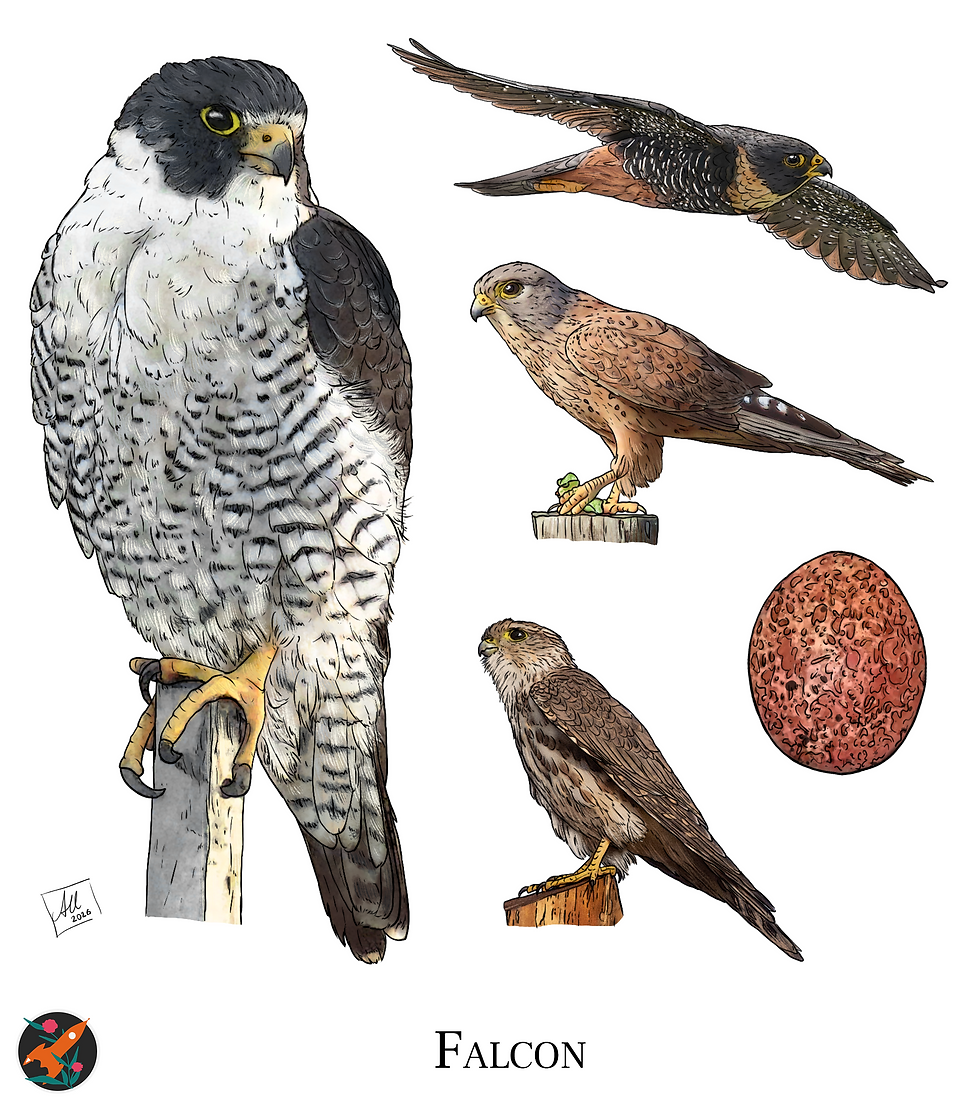
Order | Falconiformes | falcons |
Habitat | widespread on plains, forest edges, mountains, and urban areas |
Size | length 20–65 cm, wingspan 37–130 cm, weight 0.05–2.1 kg |
Lifespan | 5–15 years, up to 25 in captivity |
Diet | birds, fish, reptiles, small mammals |
Flight | among the fastest flying birds, strong and agile, high-speed dives |
Plumage | gray, brown, reddish, white |
References
Ancient Egyptian gods—Ra, Horus, and Khonsu—are all represented with falcon heads and solar and lunar attributes, to signify their association with the sky and celestial objects. In other areas, falcons have been used as hunting birds for thousands of years; the earliest evidence comes from the Late Glacial period (ca. 23,000 BCE) at the site Ohalo II (Sea of Galilee), where falcon bones were found, indicating the use of trained birds in hunting (The History of Magic: From Alchemy to Witchcraft, from the Ice Age to the Present by Chris Gosden, 2020). The conservation efforts of organizations like The Peregrine Fund led to a significant recovery of the endangered species.
Zoologist's Primer: Birds
The text above is an excerpt from Zoologist's Primer: Birds by Anna Urbanek and Jakub Wisz from Double Proficiency, published by Hunters Entertainment.
The book is currently on Kickstarter—fully funded, and we've unlocked multiple stretch goals, including the first round of donations to bird conservation charities. So far, we've donated $1000 to The Peregrine Fund, helping birds of prey; falcons included!
Here's how you can help:


https://keonhacai.cam/ mình thấy mấy hôm nay nhiều người nhắc nên cũng tò mò bấm vào coi thử giao diện thế nào. Mình không có ngồi soi nội dung hay chọn từng mục gì đâu, chủ yếu lướt qua xem họ sắp xếp trang ra sao cho dễ nhìn. Ấn tượng đầu là bố cục khá gọn, các phần được chia thành từng khối rõ ràng nên kéo xuống không bị “ngợp”. Menu cũng đặt chỗ dễ thấy, bấm chuyển qua lại giữa các mục khá nhanh, không phải mò mẫm nhiều. Mấy bảng thông tin hiển thị theo dạng cột nhìn sạch sẽ, chữ không quá rối nên đọc lướt vẫn nắm được ý. Nói chung mình thích kiểu trình…
Bài viết rất dễ áp dụng, nhất là các ví dụ nhỏ bạn đưa ra, cảm ơn bạn đã chia sẻ. Dạo này mình cũng hay để ý cách các nền tảng giải trí trực tuyến sắp xếp giao diện. Mình tự gom vài ý hay gặp vào một trang để tiện xem lại và so sánh. Ai quan tâm thì ghé thử. Ai quan tâm số liệu cập nhật theo ngày có thể ghé hồ sơ https://truckymods.io/user/532067